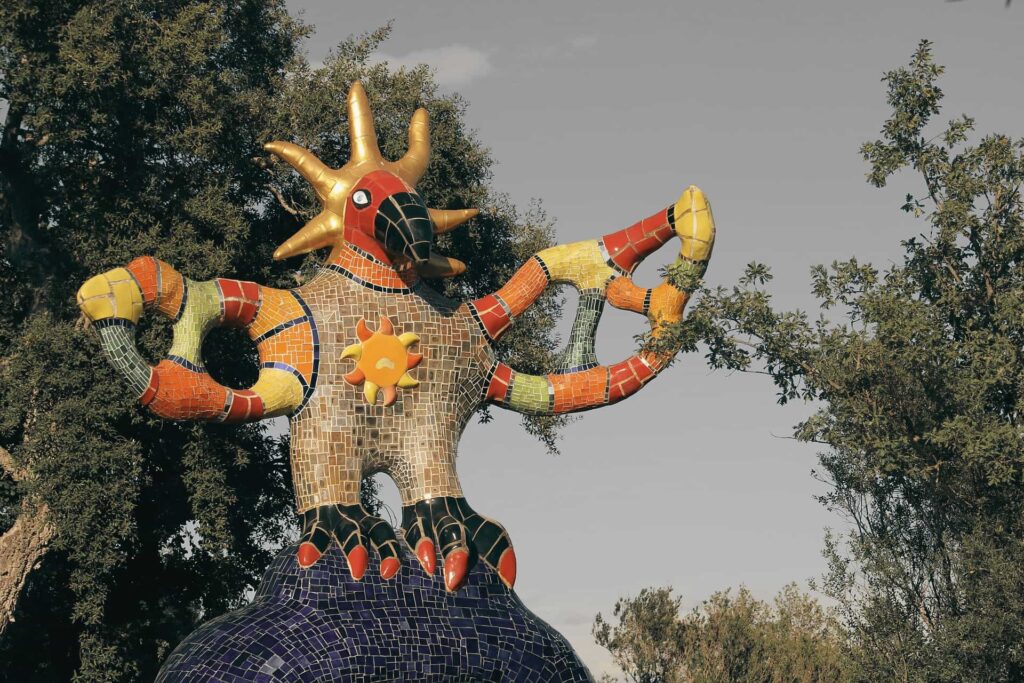
There's a point, in the countryside between Capalbio and the sea, where the Maremma briefly ceases to be what we know. The vineyards thin out, the scrub thickens, and then, suddenly, something glimmers among the foliage: a mirror, a sliver of blue ceramic, a curve that doesn't belong to any tree. Those arriving for the first time slow their pace, almost fearing they've taken the wrong turn. They haven't. They've arrived at the Tarot Garden.
It's not an amusement park, it's not a museum. It is, if anything, a woman's dream transformed into stone, glass, and color, the dream of Niki de Saint Phalle, who here, in Pescia Fiorentina, decided to build not sculptures but houses for her thoughts. Twenty-two, like the major arcana of the Tarot. Twenty-two rooms of the soul, as large as palaces, into which one doesn't just look: one enters.
A threshold, and then the silence fills with color
A thick wall, commissioned by Mario Botta, welcomes you: it separates the outside from the inside, as if to tell you that from here on, the rules change. You pass through it through a circular opening, an eye in the stone, and the world on the other side no longer has a fixed direction. There are no arrows, no marked paths. There is only the hill that rises and falls, and its mosaic creatures that await you, immobile for forty years, yet alive every time someone looks up at them.
As you walk, beneath your feet you discover phrases etched into the cement of the narrow streets, like notes left by a thought that has never truly stopped. They are Niki's words, scattered like breadcrumbs for those willing to follow them. There's no rush here: to truly explore the Garden, you need at least two hours, the time it takes for the light to change and, with it, every mirrored surface.
The crossroads of the arcana
In the central square, two figures watch you approach: the High Priestess, guardian of intuition, and the Magician, creative energy. They are the threshold between what is understood with the mind and what is merely felt, and it is from them that all the other paths of the garden branch off. A little further on, Justice stands with a weight that leaves no one indifferent—she doesn't judge just others, she seems to tell you, but you too, in this very moment.
And then there's the Star, clear, light, seemingly in dialogue with the open Maremma sky rather than the earth. Around her, the World, Death, the Sun: the great themes of every human life, told fearlessly, with colors that don't ask permission to be intense.
Living inside a work of art
There is one sculpture, among all of them, that holds something even more intimate. It is the Empress, a sphinx with soft, maternal forms: within it, for years, Niki de Saint Phalle truly lived, while the Garden's construction site grew around her. The walls are covered with fragments of Venetian mirrors, and inside there was a kitchen, a bedroom, a studio, the daily life of an artist who had chosen to literally inhabit her own dream. Thinking about it today, as the light breaks into a thousand reflections on the walls, is almost dizzying.
A construction site born from other dreams
The Garden didn't emerge from nowhere. It's the fruit of a journey Niki de Saint Phalle took in the late 1970s, from Gaudí's Parc Güell in Barcelona to the Sacred Wood of Bomarzo, here in Italy, just a little further north. She returned from those places with an idea that would stay with her for the rest of her life, and in 1979 it began to take shape in the hills of Maremma, with the contributions of artists and artisans from far and wide and with the discreet yet precious presence of her husband Jean Tinguely, who gifted the garden with his moving metal structures. Even the benches, sinuous like waves, have a story to tell: they aren't just seats, but small chapters of the same story.
When the Garden becomes an itinerary
Those who choose the Maremma for their holidays know that every stop calls to mind another. After the Tarot Garden, the medieval village of Capalbio is just a stone's throw away: its walls, accessible on foot, offer a view that reaches all the way to the sea. For those seeking silence and water, the WWF Oasis of Lake Burano holds another, more subdued, type of wonder. And if time permits, in less than an hour you can reach the beaches of Argentario or the warm, free waters of the waterfalls of Saturnia, the kind of places that Maremma offers without fanfare, to those who know how to look for them.
The park opens its doors seasonally, from April 1st to mid-October, in the afternoon. Getting there by car remains the easiest way: the Tyrrhenian coast road leads directly towards Pescia Fiorentina, to a free parking lot right in front of the entrance.
There are places you don't just visit: you pass through them, and something, as you pass through them, remains within you. The Tarot Garden is one of these, a piece of Maremma that truly never stops dreaming.